
From the first recorded AIDS death in McLean County in 1985 to the present day, our community has responded to the epidemic through reporting, activism, remembrance, and volunteer service. This timeline follows that story, including the work of the McLean County AIDS Task Force (MCATF), which operated from 1986 to 2014.
1985: The First Recorded AIDS Death
 In the summer of 1985, Herman Simon died at Bloomington’s Mennonite Hospital. He was the first recorded AIDS death in McLean County. Many people still thought of AIDS as a disease confined to big coastal cities, and his death came at a time of great fear and hysteria.
The Pantagraph ran the story on its front page under the headline “1st AIDS Death Reported Here.” It named the man who died, and readers wrote in to object. Letter writers argued that publishing his name could harm his family and discourage others from seeking treatment, and one criticized the coroner for releasing the information without telling the family. The paper responded with a note titled “Why we printed AIDS victim’s name,” saying it weighed the family’s privacy against the public’s need to know and decided the story had to be reported.
Read more:
- “AIDS Claims First Reported McLean County Victim,” Vidette, Aug. 22, 1985
- Letters to the editor and the paper’s response, The Pantagraph, Aug. 25, 1985, page 6
- “AIDS shook up McLean County,” The Pantagraph column by Dave Bentlin for the McLean County Museum of History, Nov. 30, 2025, page B4
1986: The McLean County AIDS Task Force Forms
 The task force held its first meeting in October 1986 and was incorporated that year as an agency-representative organization. According to a Feb. 25, 1987, Pantagraph article, it was led by the McLean County Health Department and included representatives from the American Red Cross, BroMenn HealthCare, Illinois State University Gay People’s Alliance, McLean County Center for Human Services, Pastoral Services, PATH, Project Oz, Planned Parenthood, and Unit 5, as well as local gay businessmen and physicians.
Several agencies each lent one staff member to help raise awareness of HIV/AIDS in the county. At first, MCATF had no fixed location and almost no budget.
1987: Dr. Brett J. Cassens ’72 Appears on PBS
 Brett J. Cassens ’72, an early AIDS treatment provider, appeared in the 1987 Peabody Award-winning PBS program AIDS: The San Diego Story. After his death in 1996, his friends, family, and colleagues endowed a scholarship in his name for queer Illinois State students pursuing a career in medicine.
1990: Art and Activism
In January 1990, queer and HIV-positive artist David Wojnarowicz drew 700 people to his opening night appearance at University Galleries.
Read more: “Controversial Exhibit Comes to ISU Galleries,” Vidette, Jan. 19, 1990
On February 2, 1990, more than 40 people gathered at University Galleries to discuss forming a local chapter of ACT UP (AIDS Coalition to Unleash Power).
Read more: Vidette story on the formation of a local ACT UP chapter, Feb. 5, 1990
1991: Banners Downtown on World AIDS Day
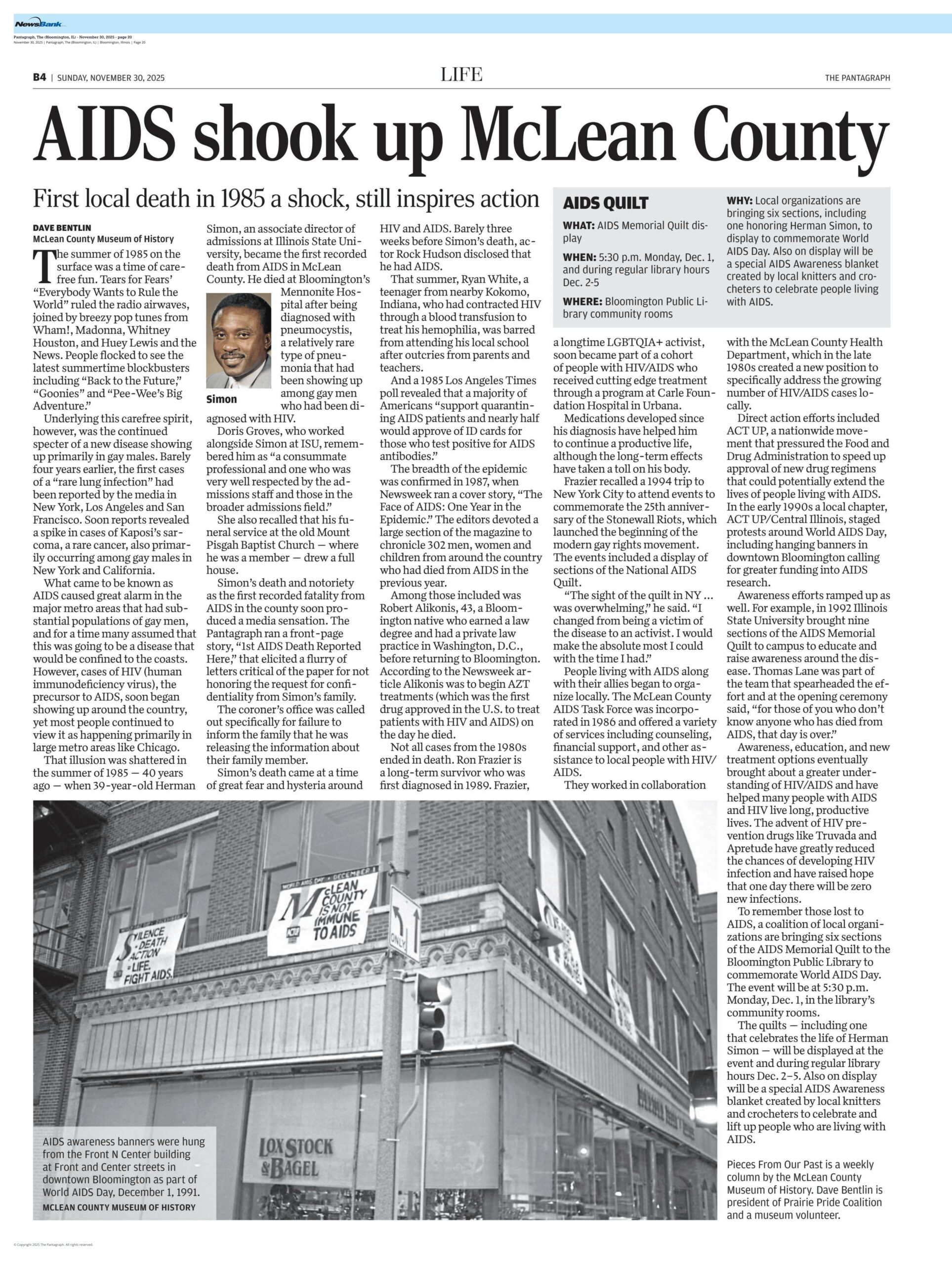
 In the early 1990s a local chapter, ACT UP/Central Illinois, staged protests around World AIDS Day. They hung banners in downtown Bloomington calling for greater funding for AIDS research.
Pictured: downtown Bloomington, on Front and Center streets, on World AIDS Day, Dec. 1, 1991. Photo credit: McLean County Museum of History
1992: The AIDS Memorial Quilt Comes to Bloomington-Normal
In September 1992, nine sections of the NAMES Project AIDS Memorial Quilt were unfolded in the Bone Student Center ballroom at Illinois State University while volunteers read aloud the names of more than 300 people represented in the display. Thomas Lane, an ISU graduate student and co-director of the campus quilt project, told the opening-day crowd that for those who don’t know anyone who has died of AIDS, “that day is over.”
Visitors were asked for donations, which raised about $2,000 for MCATF, the event’s designated beneficiary. With that money, MCATF leased a small ground-floor office in downtown Bloomington.
Read more: “Celebration of life sewn into Aids quilt,” The Pantagraph, Sept. 10, 1992, page A3
1993-1994: The Robert Thomas Estate
In late 1993, MCATF was one of five agencies asked to submit proposals for the estate of Robert Thomas, valued at about $500,000. The winning agency was to turn Thomas’s home into a hospice for people with HIV/AIDS. MCATF was the only agency to submit a proposal, but United Way turned it down because of how Thomas worded his will. After months, the courts directed that the estate go to the AIDS Foundation of Chicago (AFC), the alternative named in the will.
MCATF challenged that decision in court. In late 1994 it reached a concession agreement with AFC for $75,000 of the estate, which let MCATF help people living with HIV pay for rent, food, and utilities for many years.
One reason AFC agreed was MCATF’s work in the county. When the Illinois legislature considered eliminating anonymous HIV testing, AFC organized a statewide petition that gathered just over 5,000 signatures. MCATF supplied more than 10% of them.
1996: Remembering Wyl Moore
Bloomington resident Wyl Moore was diagnosed HIV-positive in February 1992 and talked openly about living with AIDS to reduce stigma and prevent new infections. He died in January 1996, one month short of his 40th birthday. His friend Dr. Holly Novak said his biggest contribution was “putting a face on AIDS.” His story was told in a Pantagraph series, and this article was the last installment.
Read more: “Friends Remember Moore for His Absolute Love of Life,” The Pantagraph, Jan. 21, 1996, page A1
The Late 1990s: MCATF Grows
MCATF held Dining With Friends fundraisers that raised more than $40,000 over three years. The money paid for an expansion of its facilities, including Connections Community Center. Volunteers staffed the help line and walk-in services Monday through Friday, 7:00 to 10:00 p.m., year-round, and did outreach and HIV prevention education. By the late 1990s, MCATF was also receiving HIV prevention grants from the Illinois Department of Public Health, as much as $40,000 a year.
2010-2014: Funding Ends, and MCATF Closes
State prevention funding dried up in 2010. At that point MCATF was the only remaining all-volunteer agency in Illinois receiving such funding. The shift to much leaner funding pushed MCATF to close its doors for good by the end of 2014. The money left in its treasury went to the Peoria health clinic that provided health and financial assistance to many MCATF clients.
Further Reading
- “McLean County AIDS Task Force Raises Awareness,” Vidette, Nov. 8, 2006
- “A Brief History of the McLean County AIDS Task Force,” by Bruce Lang
- “A Timeline of HIV and AIDS,” by HIV.gov